
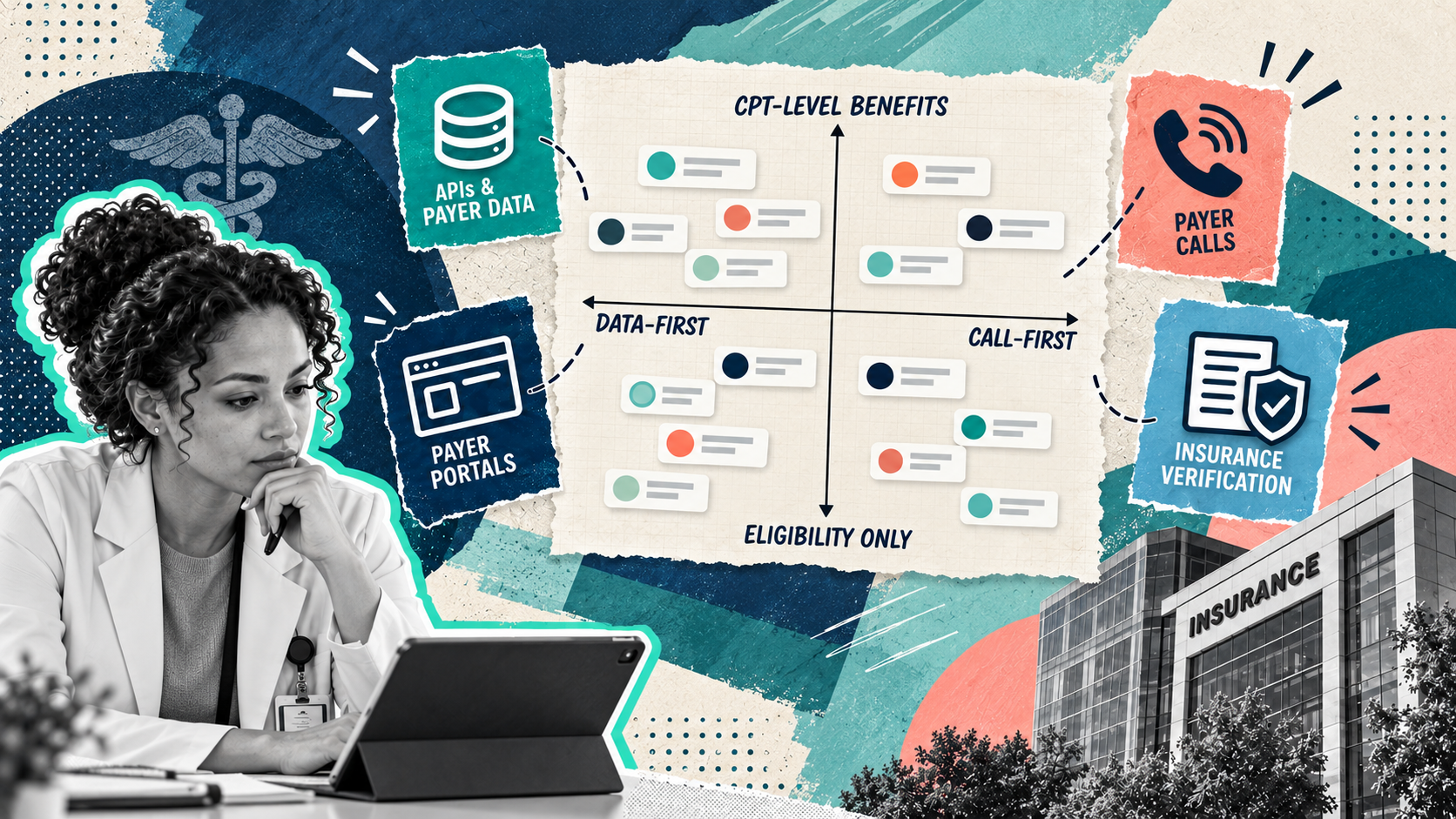
What is the best AI eligibility verification software?
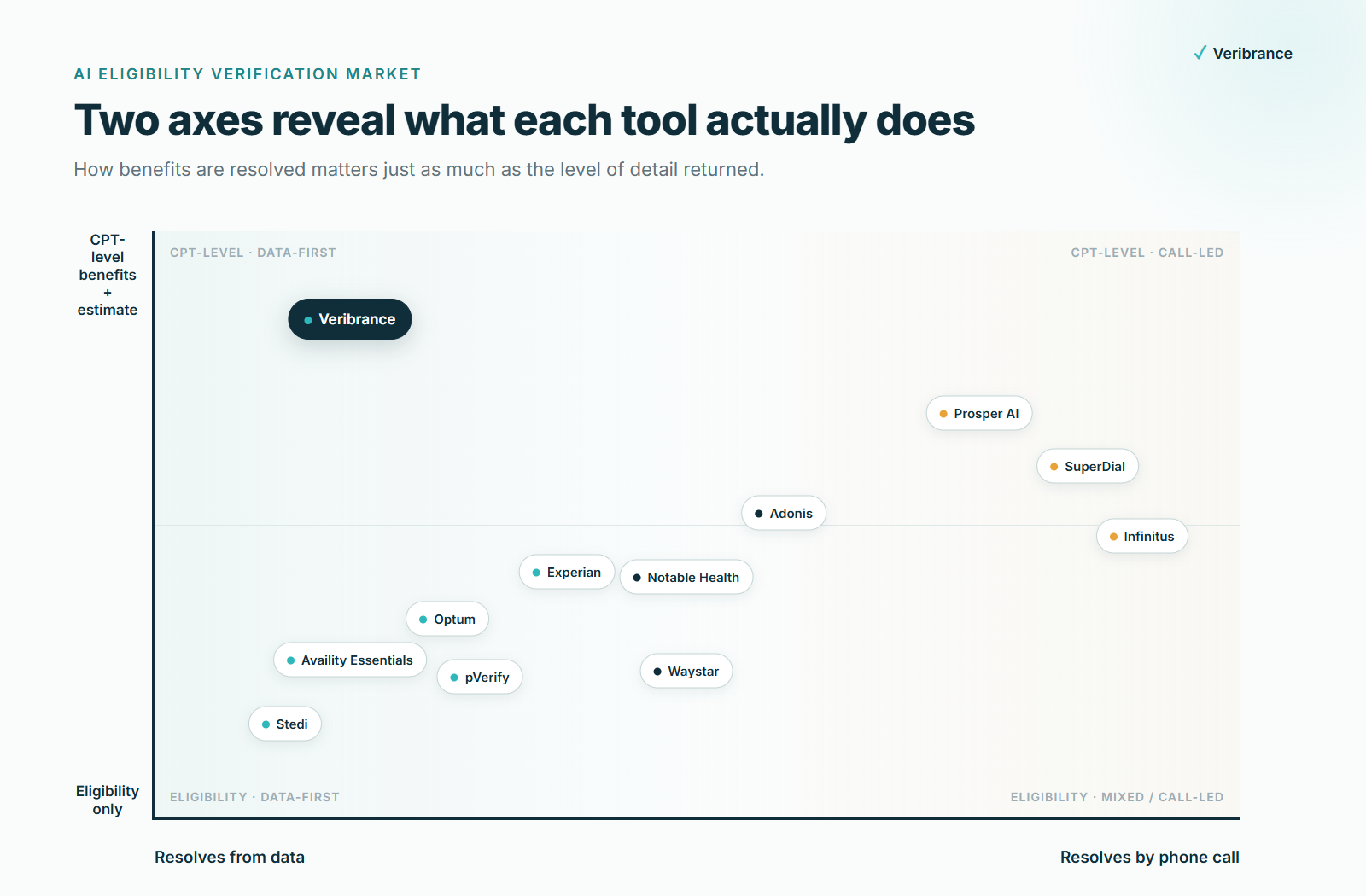
There is no single best tool, because the market splits along a line most vendors don't advertise: whether the software resolves a patient's benefits from data — EDI, payer APIs, portals, learned payer behavior — or by having an AI agent phone the payer. Which side you need depends on what you're trying to find out, how specific it has to be, and how much you can spend per check. This guide profiles twelve tools along that line, names five more, says what each one actually returns, and tells you where we'd use each.
A disclosure before anything else: we make one of these. Veribrance is listed below, in the category where it belongs, with the same fields every other vendor gets. We've tried to describe competitors from their own public materials and to say "not stated" where a vendor doesn't publish something, rather than guess.
How we evaluated these tools
Four questions, applied to every vendor.
What does it return? This is the one most comparisons skip. Some tools return eligibility — is the plan active, what's the plan-level deductible. Others return CPT-level benefits — how this procedure is covered for this provider, and what the patient will owe. The two are not interchangeable; if you're unclear on the distinction, our explainer on eligibility vs. benefits verification covers it. A vendor that says "benefits verification" but only describes plan-level fields is doing eligibility.
How does it resolve a benefit? From structured data, with AI interpreting the response? By driving payer portals? By calling the payer? Most do some combination, so the real question is which is the default and which is the fallback. Calls are the slowest, most expensive, and least consistent channel, so a tool that leads with them has a cost structure you'll feel.
Who is it built for? A health system registering 100,000 patients a month and a four-provider outpatient clinic have different problems. We say which one each tool is aimed at.
Does it publish pricing? Three of the twelve profiled do, and one of the five we name does. The others require a sales conversation. That's not disqualifying, but it's worth knowing before you book the demo.
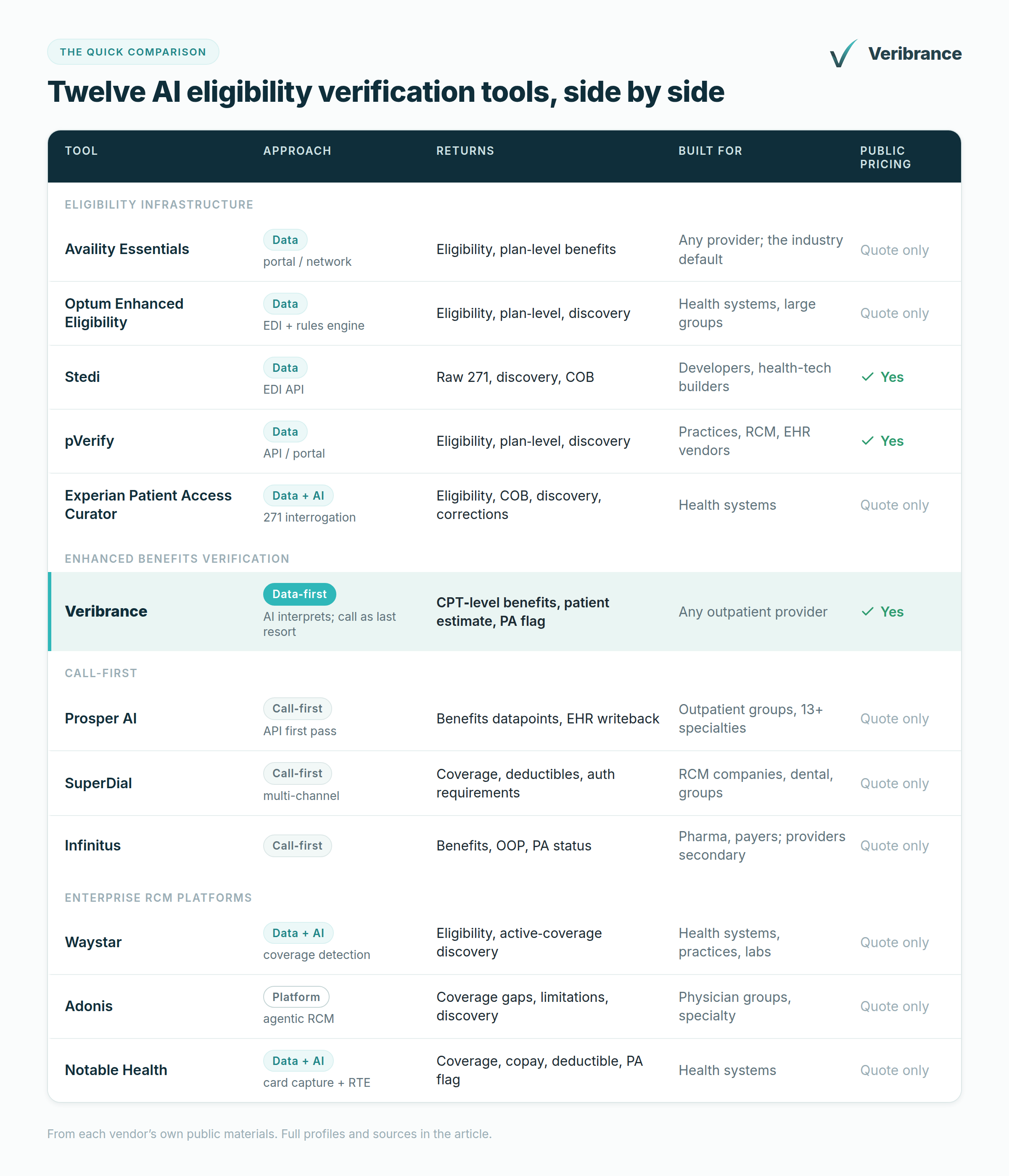
The quick comparison
- Availity Essentials. Approach: Data (portal/network). Returns: Eligibility, plan-level benefits. Built for: Any provider; the industry default. Public pricing: No.
- Optum Enhanced Eligibility. Approach: Data (EDI + rules engine). Returns: Eligibility, plan-level, discovery. Built for: Health systems, large groups. Public pricing: No.
- Stedi. Approach: Data (EDI API). Returns: Raw 271, discovery, COB. Built for: Developers, health-tech builders. Public pricing: Yes.
- pVerify. Approach: Data (API/portal). Returns: Eligibility, plan-level, discovery. Built for: Practices, RCM, EHR vendors. Public pricing: Yes.
- Experian Patient Access Curator. Approach: Data + AI (271 interrogation). Returns: Eligibility, COB, discovery, corrections. Built for: Health systems. Public pricing: No.
- Veribrance. Approach: Data-first, AI interprets; call as last resort. Returns: CPT-level benefits, patient estimate, PA flag. Built for: Any outpatient provider. Public pricing: Yes.
- Prosper AI. Approach: Call-first (API first pass). Returns: Benefits datapoints, EHR writeback. Built for: Outpatient groups, 13+ specialties. Public pricing: No.
- SuperDial. Approach: Call-first, multi-channel. Returns: Coverage, deductibles, auth requirements. Built for: RCM companies, dental, groups. Public pricing: No.
- Infinitus. Approach: Call-first. Returns: Benefits, OOP, PA status. Built for: Pharma, payers; providers secondary. Public pricing: No.
- Waystar. Approach: Data + AI (coverage detection). Returns: Eligibility, active-coverage discovery. Built for: Health systems, practices, labs. Public pricing: No.
- Adonis. Approach: Agentic RCM platform. Returns: Coverage gaps, limitations, discovery. Built for: Physician groups, specialty. Public pricing: No.
- Notable Health. Approach: AI card capture + RTE. Returns: Coverage, copay, deductible, PA flag. Built for: Health systems. Public pricing: No.
Data-first AI eligibility verification
These tools start from structured data. The best of them use AI to interpret what comes back; the simplest are the pipes everything else is built on.
Eligibility infrastructure: the layer everything sits on
Before you evaluate anything with "AI" in the name, it helps to know what the underlying transaction already gives you. These five are where most eligibility data in the United States actually comes from.
Availity Essentials
Best for: the default. If your practice checks eligibility today, there's a good chance it already runs through Availity.
Availity is the largest multi-payer network in the country — 3 million credentialed providers processing 13 billion transactions a year. Essentials returns real-time eligibility and plan-level benefits, member ID cards, cost estimates, and claim status in one portal. Its Advanced Real-Time Eligibility tier consolidates what used to be several inquiries into one. Availity doesn't claim AI for eligibility itself; its AI story is Availity Extend, an automation layer launched in April 2026. Pricing: not public. Worth knowing: Availity is the baseline every other tool here is trying to improve on.
Optum Enhanced Eligibility
Best for: health systems and large groups already on the Optum network.
The 270/271 transaction exposed as a JSON API, with a customer-specific rules engine for deduplication, payer aliasing, NPI management and self-pay validation (Medicare MBI lookup, Medicaid discovery, commercial payer discovery). Returns plan membership, copays, coinsurance and deductibles "in a simple, human-readable format." It's rules, not AI — Optum reserves the machine-learning language for its separate Patient Financial Clearance product. Pricing: quote only. Worth knowing: this is Change Healthcare's eligibility product under the Optum name, following the 2022 acquisition.
Stedi
Best for: developers building eligibility into their own software.
A pure 270/271 API clearinghouse — JSON in, JSON or X12 out, 3,500+ payers, real-time or batch. No AI interpretation layer; Stedi hands you the raw 271 and leaves the reading to you. Separate products for insurance discovery, MBI lookup and coordination of benefits. Pricing: public and per-transaction — eligibility checks from $0.30 down to $0.08 at volume; discovery from $1.50 to $0.65; no monthly minimum. Worth knowing: raised $70M in August 2025 co-led by Stripe. If you want to know what an eligibility transaction costs with nothing on top, this is the number.
pVerify
Best for: practices and RCM companies that want API or portal eligibility without building it.
Real-time eligibility across 1,500+ payers via REST, X12, HL7 and FHIR, with insurance discovery, MBI lookup and claim status as add-ons. Returns benefits, copays, deductibles, authorizations and patient responsibility at plan level. No AI claims. Customers include Optum, WebPT, Thriveworks and Weave. Pricing: public — Advanced Eligibility from $125/month for 500 transactions to $395/month for 1,500; onboarding $495–$950. Worth knowing: a dependable mid-market option, and one of only four vendors here that tell you the price upfront.
Experian Health Patient Access Curator
Best for: health systems that lose revenue to coordination-of-benefits and registration errors.
The one infrastructure-tier tool where the AI does real work. Patient Access Curator doesn't run the eligibility check; it interrogates the 271 that comes back — flagging secondary and tertiary coverage, predicting plan types, fixing COB primacy, validating MBIs and demographics — and writes corrections back into the host system in under 30 seconds. Introduced in early 2024 via Experian's acquisition of Wave HDC. Experian reports 45% fewer registration denials, 33% fewer COB denials and 35% fewer eligibility and timeliness denials; OhioHealth is a quoted customer. Pricing: not public. Worth knowing: this is eligibility correction, not benefits verification. It won't tell you what the patient owes for a given CPT code.
Enhanced benefits verification: CPT-level detail and a patient estimate
This is where the eligibility transaction stops and the real work starts. Everything above tells you whether a plan is active and what its plan-level deductible is. Nothing above tells you how a specific procedure is covered for a specific provider at a specific place of service, or what number to collect at the front desk. That requires applying CPT codes, provider NPI, place of service and your own fee schedule to the benefit data — and it's the category we built Veribrance for.
Veribrance — this is our product
Best for: outpatient providers of any kind — primary care, specialty practices, telehealth, DME suppliers, diagnostic centers — that need a collectible patient estimate before the visit, not just a green checkmark.
SmartVerify AI verifies benefits at the CPT level: network status for the specific payer–provider–location combination, which deductible applies and how much remains, copay versus coinsurance for that code, visit limits, and whether prior authorization is required — then applies your fee schedule and returns a patient estimate and a plain-language benefit explanation. It resolves from data first: EDI, payer connections, published payer rules, your contracts, and what it has learned from your EOBs. More than 95% of verifications complete without a payer phone call; an AI voice agent handles the rest, and a human confirms the output before it reaches you. Estimate accuracy is 90–95%. Built for any outpatient provider, from primary care and specialty practices to telehealth, DME suppliers and diagnostic centers; delivered through your EHR or practice management system, a web app, a website widget or an API. Pricing: public — $399/month plus a one-time setup fee, first 500 patient estimates each month free, no long-term contract. Worth comparing against the right line item: Veribrance can replace your clearinghouse check, but that's a fraction of what it does. What the fee really replaces is the staff time spent reading responses, chasing portals and calling payers. Worth knowing: we publish our pricing and our accuracy figure because we think the category should.
Other data-first vendors in this space. Several well-funded companies describe specialty-specific benefits verification. From their own public materials: Sohar Health and Nirvana both serve behavioral health and telehealth, returning eligibility, network status and cost estimates, with Nirvana adding cardless coverage discovery; neither states CPT-level benefit detail. Silna Health focuses on ABA, physical therapy and cardiac rehab, pairing benefit checks with prior-authorization submission, and publishes per-transaction pricing. Infinx combines AI agents with its own RCM staff who handle exceptions, aimed at hospitals, ASCs and specialty groups. Collectly launched Billie AI in October 2025, applying LLM analysis to 271 responses and portal data with CPT and ICD context, as a module of its patient-payments platform. All are credible; when you evaluate any of them, ask the same question you'd ask us — does the output include the CPT code, the place of service and the rendering provider, and does it end in a number you can collect?
Call-first AI eligibility verification
These vendors lead with an AI agent that phones the payer, navigates the IVR, waits on hold and talks to a representative. It's a real capability and sometimes the only way to get an answer. It's also the slowest and most expensive channel, and two reps at the same payer will answer the same question differently on the same day — so the better vendors here have added data channels to reduce how often the agent has to dial.
Prosper AI
Best for: outpatient groups across many specialties that want phone-based verification with an API first pass.
Prosper's "Alex" voice agents are trained on what the company says is 190M+ patient interactions. The company states that 80% of verifications resolve instantly via API; the rest go to an agent that calls the payer, returning up to 60 datapoints and writing to the EHR. Serves 13+ specialties with 80+ integrations including athenahealth. Raised a $30M Series A led by Andreessen Horowitz in June 2026. Pricing: not public. Worth knowing: Prosper publishes its own comparison of this market, which is worth reading alongside this one.
SuperDial
Best for: RCM companies and dental groups with high call volume to payers.
Describes itself as "the enterprise AI platform for payer operations." Voice agents call payers, but SuperDial also drives portals, APIs and EDI, reaching for voice or portal channels when a structured transaction comes back incomplete or ambiguous. Returns coverage, deductibles, copays, out-of-pocket balances, carve-outs, network status and auth or referral requirements, with transcripts or evidence links; its voice agents record, transcribe and attach confidence scores to each interaction. Integrates with Epic, athenahealth, Tebra, ModMed and OpenDental among others. Over a million calls handled; $15M Series A led by SignalFire in June 2025. Pricing: not public. Worth knowing: CPT-level benefits aren't explicitly stated; "service-specific benefit retrieval" is listed as a use case.
Infinitus Systems
Best for: pharmaceutical manufacturers and payers running benefits verification at national scale.
The largest company here by funding and volume — roughly $103M raised per MobiHealthNews, a valuation Bloomberg put above $600M, and 350M interactions automated for customers including Amgen, Pfizer, UnitedHealthcare and Aetna. AI agents collect data digitally before calling, using a payer knowledge graph and clearinghouse partnerships, then phone to fill the rest. Pricing: not public. Worth knowing: Infinitus is built for pharma access programs. Its provider-practice offering is thin on its own site, and an outpatient practice is unlikely to be its target customer.
Enterprise RCM platforms with an AI eligibility layer
Eligibility is one module in a broader revenue-cycle platform. If you're buying the platform, the eligibility piece comes with it; if you're buying eligibility, these are more than you need.
Waystar
Best for: health systems and practices already on Waystar that want eligibility denials caught automatically.
Coverage Detection runs when an eligibility check comes back inactive or subscriber-not-found at registration, on eligibility rejections during claim processing, during claim status checks, and when a denial points to an eligibility error, drawing on Waystar's claims and eligibility databases. Based on its 2024 data, Waystar says 30–40% of patients who present as self-pay have active coverage it finds. AltitudeAI is the platform-wide AI brand launched in April 2025; how it applies to eligibility specifically isn't spelled out. Six billion transactions a year, about a million providers. Pricing: not public. Worth knowing: Waystar acquired Olive AI's clearinghouse and patient-access units when Olive wound down in 2023.
Adonis
Best for: physician groups that want agentic AI across the whole revenue cycle.
Adonis describes an eligibility and benefits agent that checks coverage in real time and surfaces coverage gaps, limitations and documentation requirements, plus instant coverage discovery. How the check is performed — EDI, portal, or otherwise — isn't specified. Customers include ApolloMD, Fox Valley Orthopedics, Allied Digestive Health and Mount Sinai; integrations with Epic, athenahealth, NextGen and ModMed. Raised a $40M Series C in March 2026, bringing total funding to $95M per the company. Pricing: not public. Worth knowing: Adonis publishes denial-reduction results per customer, but no eligibility accuracy figure.
Notable Health
Best for: health systems automating registration at scale.
AI agents read the insurance card, verify coverage with the payer in real time, and write active status, copay, deductible and prior-auth requirements back into the EHR. Integrated Optum's real-time eligibility APIs in February 2026. Customers include CommonSpirit, MUSC Health and UC San Diego Health; Notable reports 1.5 million tasks automated daily across 12,000 sites of care. Pricing: not public. Worth knowing: the card-reading is real AI; whether the eligibility response itself is interpreted by AI isn't stated.
How to choose
If you're an outpatient provider — primary care, specialty, telehealth, DME, a diagnostic center — and the thing you actually need is a number to collect at check-in, you need CPT-level benefits verification, and the field is short. Veribrance is built for it; the vendors in the "other data-first" paragraph are worth a look depending on your setting. Ask each for a pilot on 20–50 real patients and compare the outputs to the EOBs.
If you're a health system, your eligibility problems are mostly registration quality, coordination of benefits and self-pay patients who actually have coverage. Experian's Patient Access Curator, Waystar's Coverage Detection and Notable are built for exactly that, and all three assume health-system scale.
If you're an RCM company or dental group burning staff hours on payer phone calls, the call-first vendors are the honest fit — SuperDial in particular has built data channels around the voice agent so the call share drops over time.
If you're building software and need eligibility inside your own product, Stedi and pVerify give you the transaction with published pricing, and you decide what to layer on top.
Whatever you choose, run the three-input test: does the tool ask for a CPT code, a place of service and a rendering provider NPI? If it doesn't, it isn't verifying benefits. It's verifying eligibility, which is useful and different. We wrote a longer piece on what AI eligibility verification actually does if you want the mechanics before you book demos.
Frequently asked questions
What's the difference between AI eligibility verification and a regular eligibility check?
A regular check is a 270/271 transaction through a clearinghouse: it returns whether the plan is active and its plan-level benefit fields. AI eligibility verification adds a layer that interprets that response, fills gaps from payer portals or coverage discovery, and in some tools applies CPT codes, provider and place of service to produce a patient estimate. The underlying transaction is the same; the interpretation is what's new.
Do AI eligibility verification tools call the insurance company?
Some do by default — Prosper, SuperDial and Infinitus lead with AI voice agents. Others resolve from data and call only when structured sources can't answer — Veribrance completes more than 95% of verifications without a call. Calls are slower and costlier, so the share of verifications that need one matters to your bill.
Which tools return CPT-level benefits rather than plan-level eligibility?
Of the tools here, Veribrance states CPT-level verification explicitly. Collectly's Billie AI describes CPT- and ICD-aware interpretation. SuperDial lists service-specific benefit retrieval as a use case. The infrastructure tools and enterprise platforms return plan-level benefits.
Which vendors publish pricing?
Stedi (per transaction, from $0.30 down to $0.08), pVerify ($125–$395 per month by volume), Silna Health (per-transaction pricing on its homepage) and Veribrance ($399 per month plus setup, first 500 estimates free). Every other vendor in this guide requires a sales conversation. Note that these aren't like-for-like. Stedi and pVerify price the eligibility transaction and stop there. Veribrance can run that transaction too, but it's the smallest part of what the fee covers — the rest is everything a clearinghouse leaves to your staff: interpreting the response, chasing portals, calling payers, applying your fee schedule and producing an estimate. The fair comparison is against the hours your team spends on verification, not against a per-check fee.
How accurate is AI eligibility verification?
Vendor claims range from 90% to 99%, but they measure different things: transaction success, data-field accuracy, or estimate accuracy against the final EOB. Ask which one a vendor means. Veribrance's 90–95% figure is estimate accuracy — how close the pre-visit number is to what the patient actually owed.
Want to see what CPT-level verification returns for your patients? Try the free cost estimator, or book a demo and we'll run a pilot on your own cases.
Sources
Vendor descriptions are drawn from each company's own website and the following coverage:
- Fierce Healthcare — SuperDial raises $15M Series A (June 2025)
- Becker's — Prosper AI raises $30M (June 2026)
- TechTarget — Adonis raises $40M (March 2026)
- Business Wire — Experian acquires Wave HDC (November 2023)
- Waystar — AltitudeAI launch (April 2025)
- Stedi — Series B (August 2025)
- Notable Health — Optum Real APIs integration (February 2026)
- Fierce Healthcare — Olive AI winds down (October 2023)