
What is AI eligibility verification?
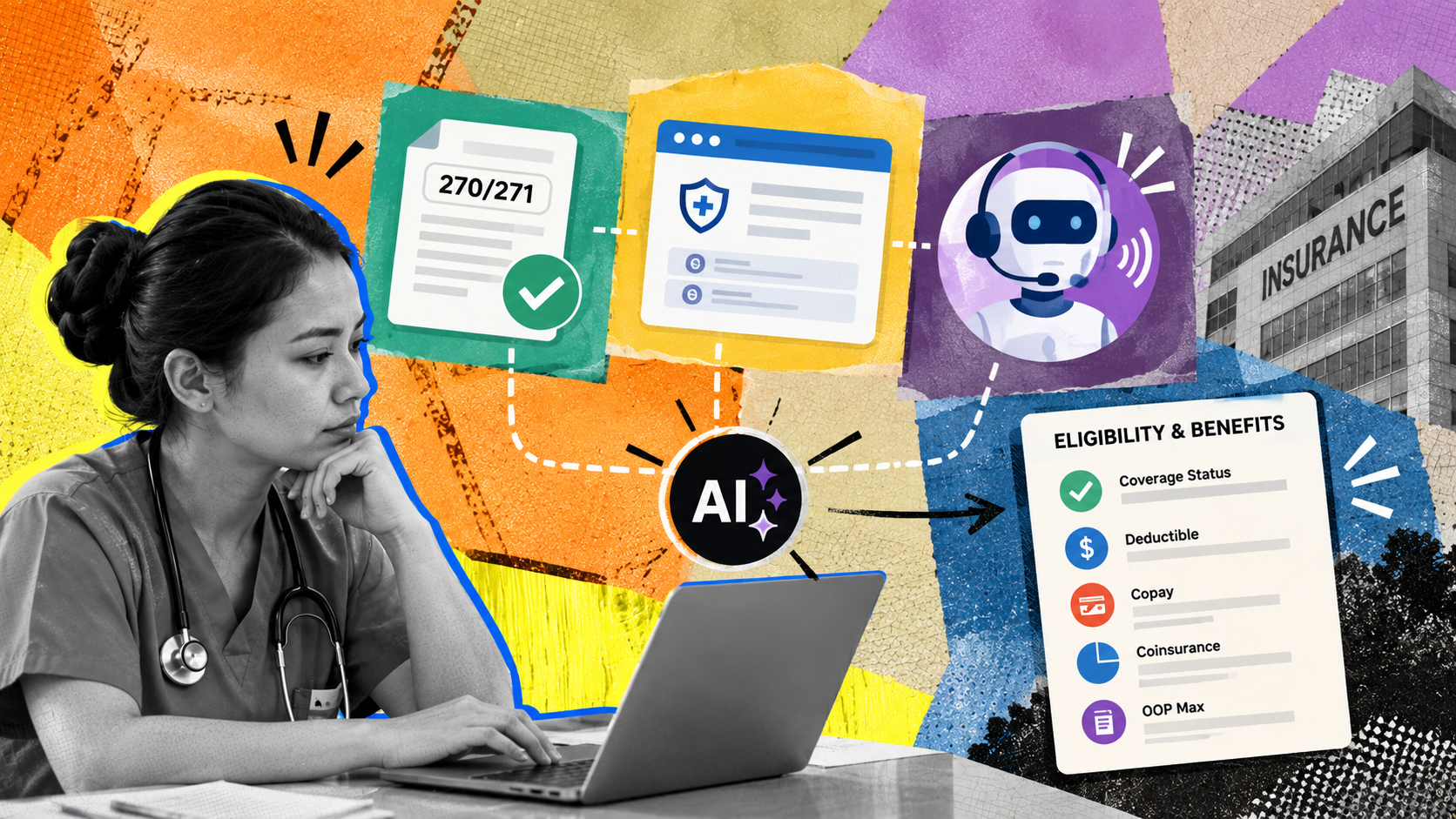
AI eligibility verification is software that uses artificial intelligence to turn a payer's eligibility response into something a practice can act on. The underlying check — a 270/271 transaction through a clearinghouse — hasn't changed. What the AI adds is interpretation: reading the response, filling gaps from payer portals or coverage discovery, applying procedure codes and provider details, and in some tools, phoning the payer when the data runs out. The output ranges from "coverage is active" to "this patient owes $612 for this procedure."
That range is the whole story. Two products can both be called AI eligibility verification and do almost nothing alike, because "AI" describes the method and not the result. So this guide is organized around three questions that cut through the label: what is the AI actually doing, how does the tool resolve a benefit when the data is incomplete, and what does it hand you at the end.
The category is growing fast and buyers are rightly cautious about it. In an Experian Health survey of 200 provider decision-makers, fielded in October 2025, nearly two-thirds said they already use AI somewhere in revenue cycle, and 52% put eligibility and benefits verification among their top three AI opportunities — yet only 5% said they would trust AI to make critical decisions on its own. That gap between "we use it" and "we trust it" is the right frame for everything below.
If you're deciding between specific tools, we've compared twelve of them along these same lines. This piece is the mechanics.
What does the AI actually do?
It helps to start with what the AI isn't doing. It isn't checking eligibility. That's a standardized electronic transaction — a 270 inquiry goes to the payer, a 271 response comes back — and it has worked the same way for twenty years. Availity, Optum, Stedi and pVerify will run it for you in seconds for a few cents. If a vendor's AI story is "we check eligibility automatically," they're describing the clearinghouse.
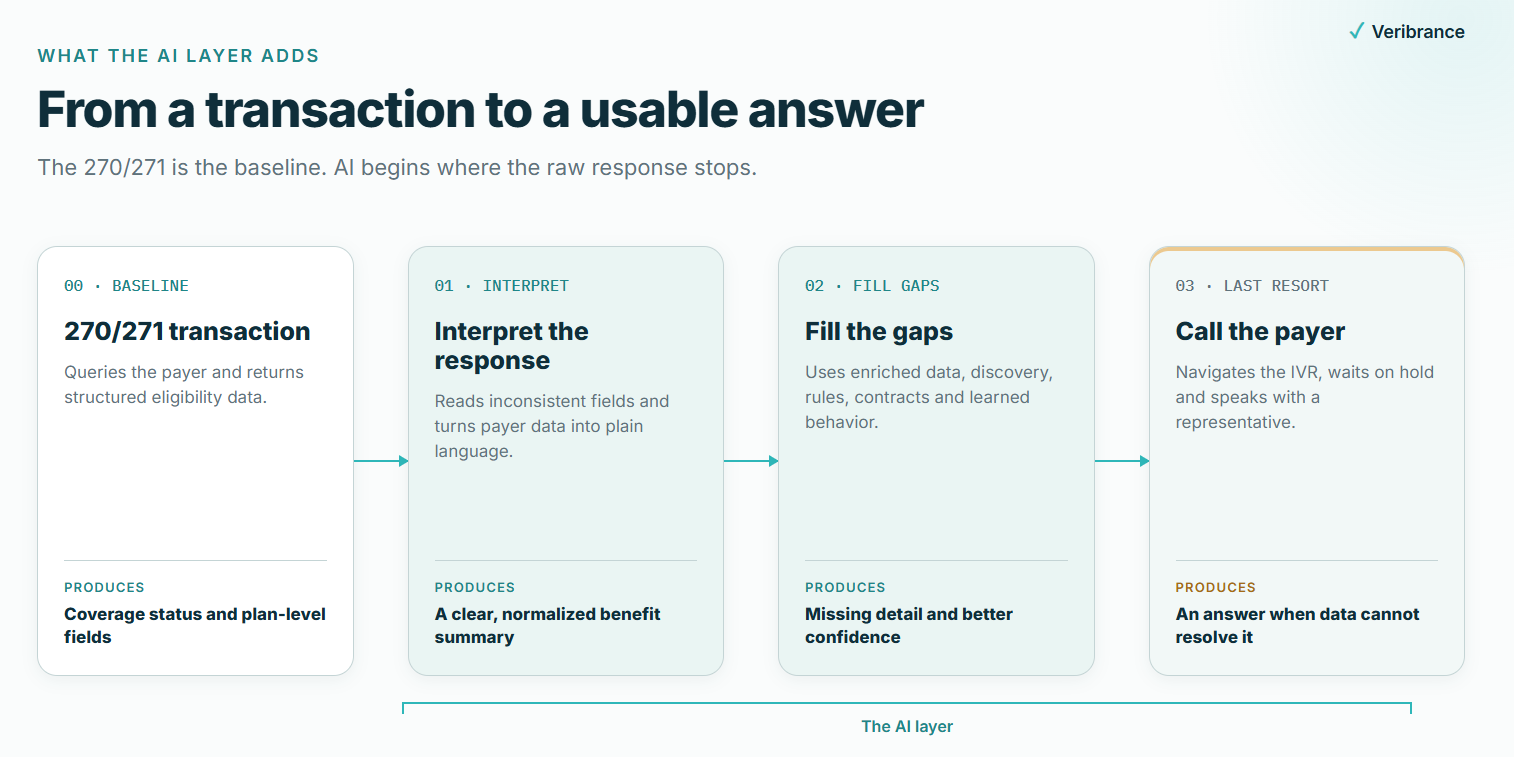
The AI shows up in three jobs that sit on top of that transaction.
Interpreting the response. A 271 can carry dozens of service-type codes, each with its own benefit values, and payers populate them inconsistently — the same benefit labeled three ways, deductibles that may or may not apply to the service in question, authorization flags that are present for one payer and missing for the next. The first job of AI here is reading that mess and deciding which lines apply to the patient and procedure in front of you. Experian's Patient Access Curator does a version of this for coordination of benefits, interrogating the 271 for signs of secondary coverage. Collectly's Billie AI describes LLM analysis of the 271 with CPT and ICD context. Veribrance's SmartVerify does it to determine which deductible applies to a given CPT code.
Filling the gaps. Often the 271 doesn't contain what you need. Service-level benefits, visit limits, carve-outs and prior-auth rules frequently live in payer portals, plan documents or the payer's published policies rather than in the EDI response. The second job is going to get them — driving portals, running coverage discovery when the member ID is wrong, pulling the payer's medical-necessity criteria — and reconciling what comes back with the transaction data.
Calling the payer. When neither the transaction nor the gap-filling produces an answer, the last resort is a phone call. AI voice agents now make those calls: they navigate the IVR, wait on hold and talk to a representative. Prosper, SuperDial and Infinitus have built companies around this. It works, and sometimes it's the only way to get a specific answer. It's also the slowest and most expensive channel, and two representatives at the same payer will answer the same question differently on the same day — which is why how a vendor sequences these three jobs matters more than whether it does them.
Data-first or call-first: the axis that actually matters
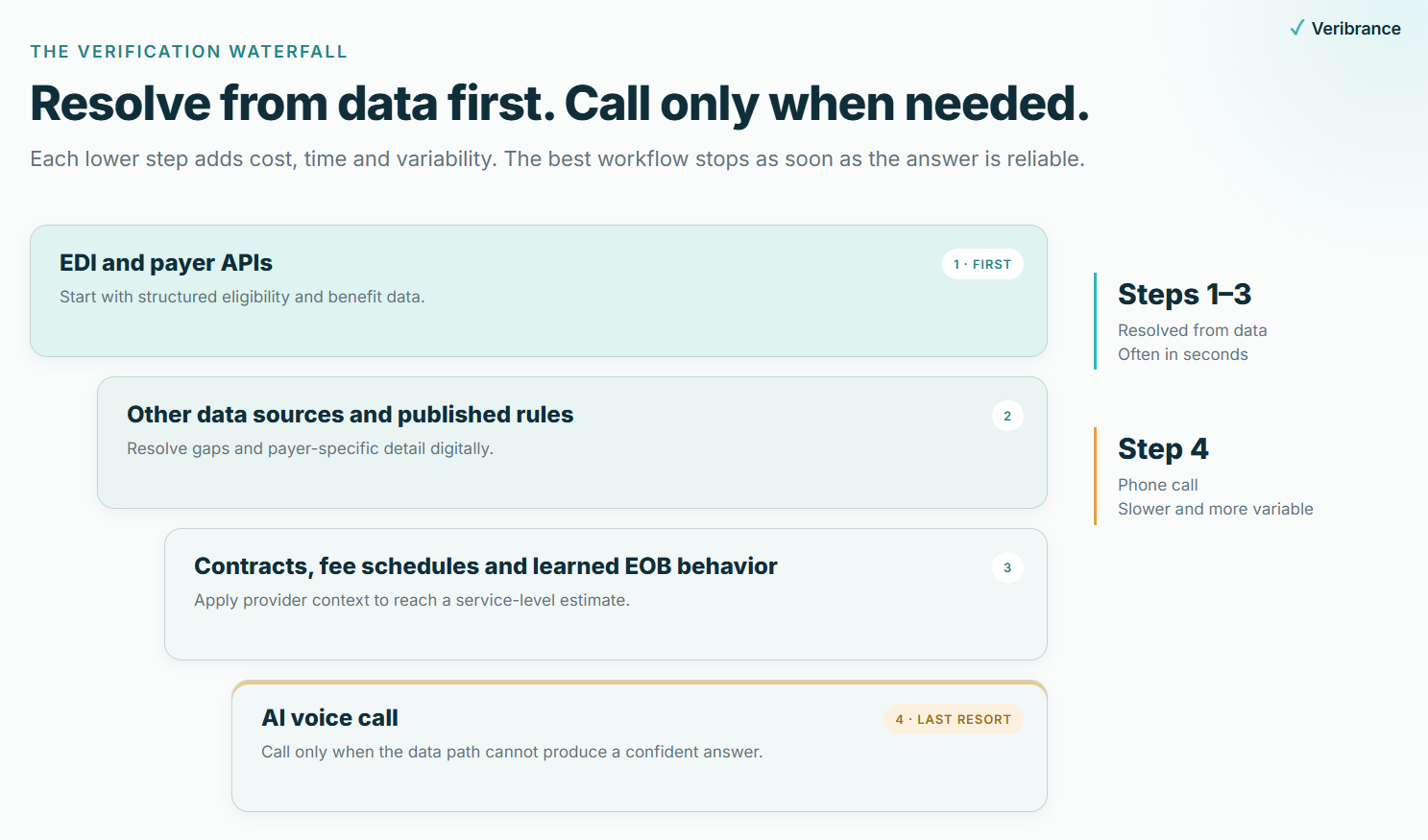
Every AI eligibility verification tool does some mix of the three jobs above. The useful distinction is which one it reaches for first.
Call-first tools treat the phone call as the product. An agent dials the payer for most or all verifications, and data channels — where they exist — reduce how many calls are needed. This is the right design when the information genuinely isn't available electronically, which is still common for some payers and some benefit types, and when the alternative is a human on hold for twenty minutes. It's also the design that scales cost with volume, because every call has a duration.
Data-first tools treat the call as the exception. They exhaust structured sources — the 271, payer APIs, published payer rules, the provider's own contracts and fee schedules, and what the system has learned from past EOBs — and resolve the large majority of verifications from data alone, in seconds. The voice agent picks up the phone only for the residual cases where nothing else can answer, and that share shrinks as the system learns a practice's payer mix. The tradeoff is upfront configuration: a data-first tool needs your fee schedules and a stack of representative EOBs before it's useful, where a call-first tool can start dialing on day one.
Most vendors sit somewhere between the two and few say where. Prosper publishes a useful number — 80% of its verifications resolve via API, the remainder by a call — which is the kind of disclosure the category needs more of. Since we're asking for it, here's ours: more than 95% of Veribrance verifications complete without a payer call. When you evaluate a tool, ask what share of verifications end in a phone call, and whether that share is going up or down for existing customers. A vendor that calls on everything is selling you a call center with a chatbot on top.
What does AI eligibility verification return?
This is where the label does the most damage, because "eligibility verification" and "benefits verification" get used interchangeably and they are not the same thing. We've written a full explainer on the difference; the short version is that eligibility tells you the plan is active and benefits verification tells you what the plan pays for a specific procedure, by a specific provider, at a specific place of service.
Most AI eligibility tools return the first and some of the second. A plan-level deductible and out-of-pocket maximum. Coverage status. Perhaps copay for a visit type. Coverage discovery when the member ID was wrong. Correction of demographics and coordination of benefits. These are real improvements over a raw 271, and for a health system registering thousands of patients a day, they're the ones that matter.
A smaller set returns CPT-level benefits: whether this code is covered, which deductible applies to it and how much of it is left, copay versus coinsurance for that code specifically, visit limits with the count used, network tier for this provider at this location, and whether prior authorization is required for this procedure. Apply the provider's fee schedule to that and you have a patient estimate — a number the front desk can collect.
The quickest way to tell which one a tool returns is the inputs. Eligibility needs a name, a date of birth and a member ID. Benefits verification needs those plus a CPT code, a place of service and a rendering provider NPI. If the tool never asks for the second set, it can't be returning CPT-level benefits, whatever the marketing says.
How is it different from what my EHR already does?
Your EHR or practice management system almost certainly runs eligibility checks today, usually through Availity or a clearinghouse connection, and displays a status. That's a real 270/271 and it's worth having on every appointment. What it doesn't do is any of the three AI jobs: it shows you the 271 rather than interpreting it, it doesn't go to portals when the response is thin, and it doesn't call anyone. It also doesn't know your fee schedule, so it can't produce an estimate. We've laid out the comparison in detail in Veribrance vs. your EHR, but the one-line version is that the EHR check is the input to AI eligibility verification, not a substitute for it.
How accurate is it?
Vendors in this category claim accuracy between 90% and 99%, and the figures are mostly not comparable because they measure different things.
Transaction success is whether the eligibility check returned a response at all. It should be close to 100% for any competent tool and tells you nothing about the quality of what came back.
Field accuracy is whether the individual data points — deductible remaining, copay amount, network status — match the payer's records. Call-first vendors tend to quote this, since each call produces a set of fields that can be checked.
Estimate accuracy is whether the dollar figure quoted to the patient before the visit matched what the EOB said afterward, within some tolerance. This is the number that matters if your goal is collecting at the front desk, and it's the hardest one to achieve because it depends on getting every field right and applying the right fee schedule and the accumulators not moving before the date of service. Veribrance's 90–95% figure is estimate accuracy; when we quote it, that's what we mean.
Two things worth knowing about accuracy in this category. First, the good tools attach a confidence score to each verification and route low-confidence cases to a human or a payer call rather than guessing — so the practical question is not "how accurate is the AI" but "what happens to the 5–10% it isn't sure about." Second, accuracy improves with configuration. A data-first tool that has seen six months of your EOBs will outperform the same tool on day one, which is why pilots should run on real patients and be compared against real remittances.
Who is it for?
The honest answer is that different parts of this market are built for different buyers, and most of the confusion comes from treating it as one category.
Health systems have an eligibility problem that is mostly registration quality: wrong plan, missing secondary coverage, self-pay patients who actually have insurance, coordination-of-benefits errors that surface as denials weeks later. Experian's Patient Access Curator, Waystar's Coverage Detection and Notable Health are built for that, at health-system scale, and they're correctly described as AI eligibility verification. None of them produce a CPT-level estimate, because that isn't the problem they're solving.
Outpatient providers — primary care, specialty practices, telehealth, DME suppliers, diagnostic centers — have a different problem. Eligibility usually comes back clean. What they can't get is the patient's actual responsibility for the procedure being scheduled, because it depends on service-level rules the 271 doesn't carry. For them, "AI eligibility verification" that stops at plan level solves nothing; they need the CPT-level layer and the estimate. That's the segment Veribrance was built for.
RCM companies and dental groups have a volume problem: hundreds of payer phone calls a day that staff could be spending on denials. The call-first vendors are an honest fit here, and the ones that have added data channels to cut call volume are the ones to look at.
Software companies building eligibility into their own product need the transaction and nothing else. Clearing houses sell it with published pricing.
What does it cost?
Three pricing shapes, from the bottom of the stack up. The transaction itself is cheap and published: Stedi charges from $0.30 down to $0.08 per eligibility check at volume; pVerify from $125 a month for 500 checks. The AI layer is priced either per verification — common among data-first vendors — or per call for voice-led tools, usually with an onboarding fee to configure provider rules and fee schedules, and a monthly minimum. Prior-auth calls and deep manual research are typically add-ons. Enterprise platforms bundle eligibility into the platform fee.
Only a handful of the vendors we compared publish their pricing. Veribrance is one of them: $399 a month plus setup, with the first 500 patient estimates each month free. One thing worth getting right when you compare: Veribrance can run the eligibility transaction itself and replace your clearinghouse check, but that's the smallest part of what the fee covers. The rest is everything a clearinghouse leaves to your staff: reading the 271, logging into portals, sitting on hold with the payer, applying your fee schedule and producing a number to collect. So the honest comparison isn't $399 against a few cents per check; it's $399 against the hours your team spends on verification each month. We think the rest of the category should publish too — a practice manager shouldn't need a sales call to learn whether a tool is in budget.
The cautionary tale
It's worth remembering that AI in revenue cycle has had a false start. Olive AI raised $902 million, reached a $4 billion valuation in 2021 on the promise of AI-automated healthcare operations, and wound down in October 2023, selling its clearinghouse and patient-access units to Waystar and its prior-authorization unit to Humata. Whatever the reasons, the lesson for buyers is simple: judge the tool on what it returns for your patients in a pilot, not on the size of the round or the breadth of the pitch. The current generation of tools is more focused and more honest about mechanism than Olive was, and the better ones will show you a confidence score and a call rate without being asked.
How to evaluate a vendor
Ask what the output includes — specifically whether it has the CPT code, the place of service and the rendering provider NPI, and whether it ends in a dollar figure. Ask what share of verifications end in a phone call and which direction that number is moving. Ask what accuracy means to them: transaction, field or estimate. Ask how low-confidence cases are handled and what the turnaround is. Ask whether they can apply your fee schedules and what onboarding needs from you. Ask whether they publish pricing.
Then run a pilot on twenty to fifty real patients and compare the output to the EOBs when they arrive. Every vendor confident in their accuracy will agree to that. Our guide to insurance verification and patient estimation walks through the estimate math if you want to check the vendor's arithmetic yourself.
Where Veribrance fits
We should be clear about where we sit on the map we've just drawn, since we drew it. Veribrance is data-first and CPT-level: SmartVerify AI resolves benefits from EDI, payer connections, published payer rules and your own contracts and EOB history, applies your fee schedule, and returns a patient estimate at 90–95% accuracy. It does not use payer portals. More than 95% of verifications complete without a payer call; an AI voice agent handles the rest, and a human confirms the output before you see it. We publish our pricing and we'd rather you ran a pilot than took our word for any of this. We've written more about where AI agents fit in benefits verification if you want the longer view.
Frequently asked questions
Is AI eligibility verification the same as automated eligibility verification?
Not quite. Automated eligibility verification usually means running the 270/271 transaction on a schedule without staff involvement — your EHR probably does it already. AI eligibility verification adds interpretation of the response, gap-filling from other sources, and sometimes a voice agent, on top of the automated transaction.
Does AI eligibility verification replace calling the insurance company?
For most verifications, yes — data-first tools resolve the majority without a call; Veribrance completes more than 95% that way. For the residual set, the call is still the only way to get an answer, and AI voice agents now make those calls. The share that still needs a call is one of the most useful numbers to ask a vendor for.
Can AI eligibility verification tell me what the patient owes?
Only if it works at the CPT level and applies your fee schedule. Plan-level tools return a deductible and out-of-pocket maximum but not the patient's responsibility for a specific procedure. Ask whether the tool takes a CPT code, place of service and provider NPI as inputs.
How accurate is AI eligibility verification?
Vendors claim 90–99%, but transaction success, field accuracy and estimate accuracy are different measures. For collecting at the front desk, estimate accuracy against the final EOB is the one that matters; 90–95% is a realistic figure for a well-configured data-first tool.
Is AI eligibility verification HIPAA compliant?
The reputable vendors are, and will say so with SOC 2 and HIPAA documentation. Voice-agent vendors handle recorded calls containing PHI and should be able to describe their retention and access policies. Ask.
What does it cost?
The raw transaction costs cents. The AI layer typically runs a few hundred dollars a month plus per-verification or per-call fees and an onboarding charge; enterprise platforms bundle it. Only a handful of vendors publish prices.
Want to see what data-first, CPT-level verification returns for your patients? Try the free cost estimator, or book a demo and we'll run a pilot on your own cases.
Sources
- 2025 CAQH Index (February 2026) — AI adoption in administrative workflows
- Experian Health — AI adoption in healthcare survey (December 2025) — 52% of providers rank eligibility and benefits verification among top AI opportunities
- Fierce Healthcare — Olive AI winds down (October 2023)
- Stedi — pricing · pVerify — pricing
- Vendor mechanism descriptions from each company's public site; see the companion comparison for per-vendor sources