
Why does the difference matter?
Two patients walk into the same imaging center on the same morning. Same carrier, same plan name on the card, same CPT code on the order. The front desk ran eligibility on both the day before and got the same result: active, PPO, all good.
The first patient pays a $20 copay and leaves. The second gets a bill four weeks later for the full deductible plus 20% coinsurance, because her plan treats that rendering provider, at that place of service, differently. Nobody at the practice did anything wrong by their own checklist. The eligibility check just never asked the question that mattered.
Or take the telehealth version. A patient is eligible, the plan covers the visit type in general, and the visit happens on video. Only afterward does anyone discover the plan doesn't cover telehealth for that particular code, and the patient's share is nothing like what they were told.
If you've ever had a patient walk out with a "you're all set" from the front desk and then call three weeks later, furious about a bill, you've already met the gap between eligibility verification and benefits verification. The patient was eligible. Nobody checked the benefits.
That gap trips up a surprising number of smart people, including plenty who work in healthcare but not in billing. Practice owners, clinicians, office managers, even folks who sell software to medical practices will use "eligibility" and "benefits" interchangeably, because their EHR shows a green checkmark and calls it "verified." And the cost of the confusion isn't abstract: it's the denied claim, the refund, the awkward phone call, and the balance that sits in A/R for four months. So let's untangle it properly, then talk about what to actually do about it.
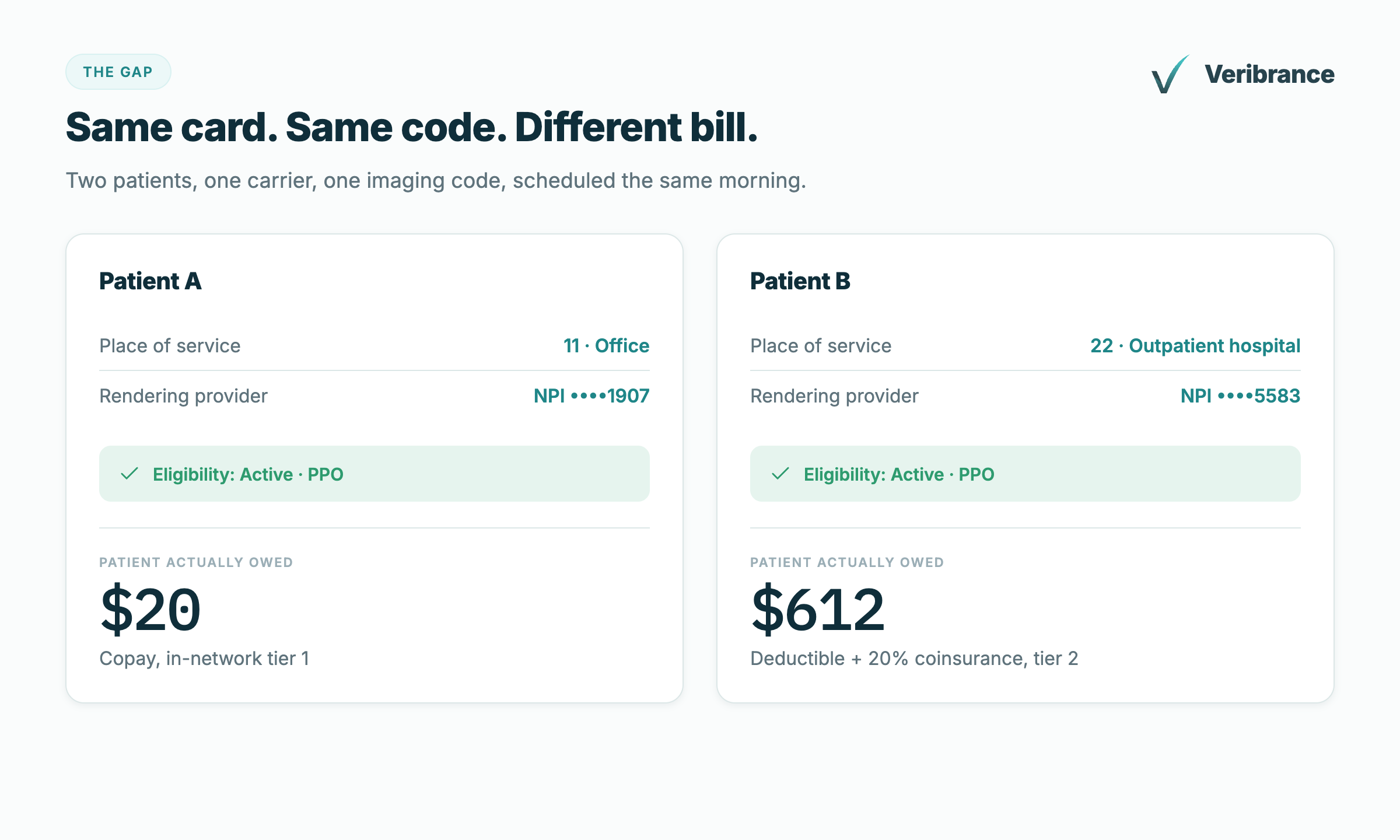
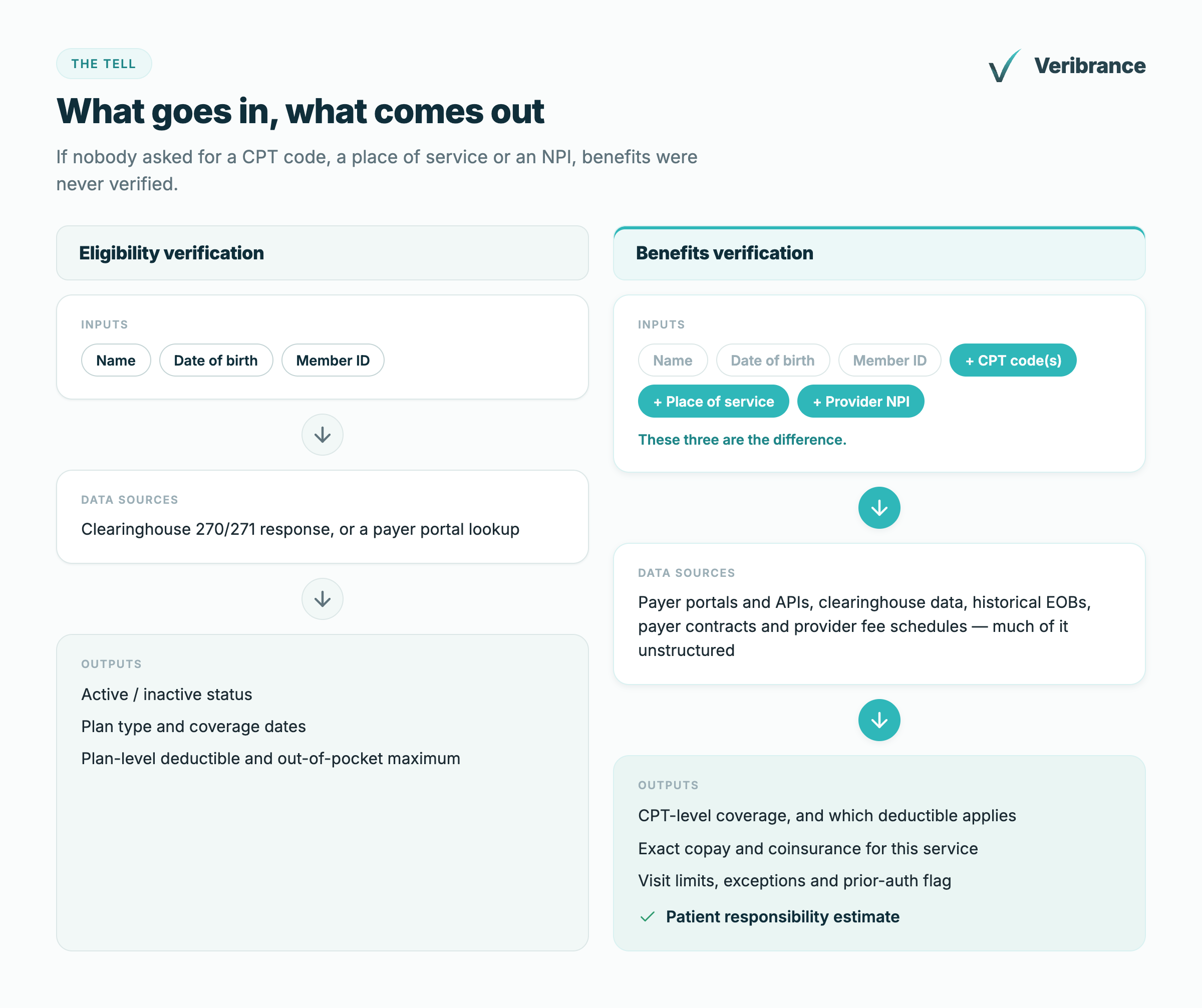
Eligibility returned the same answer for both patients. Benefits verification would have caught the difference — because it asks for the procedure, the place of service and the rendering provider. Eligibility never does.
What's the difference between eligibility verification and benefits verification?
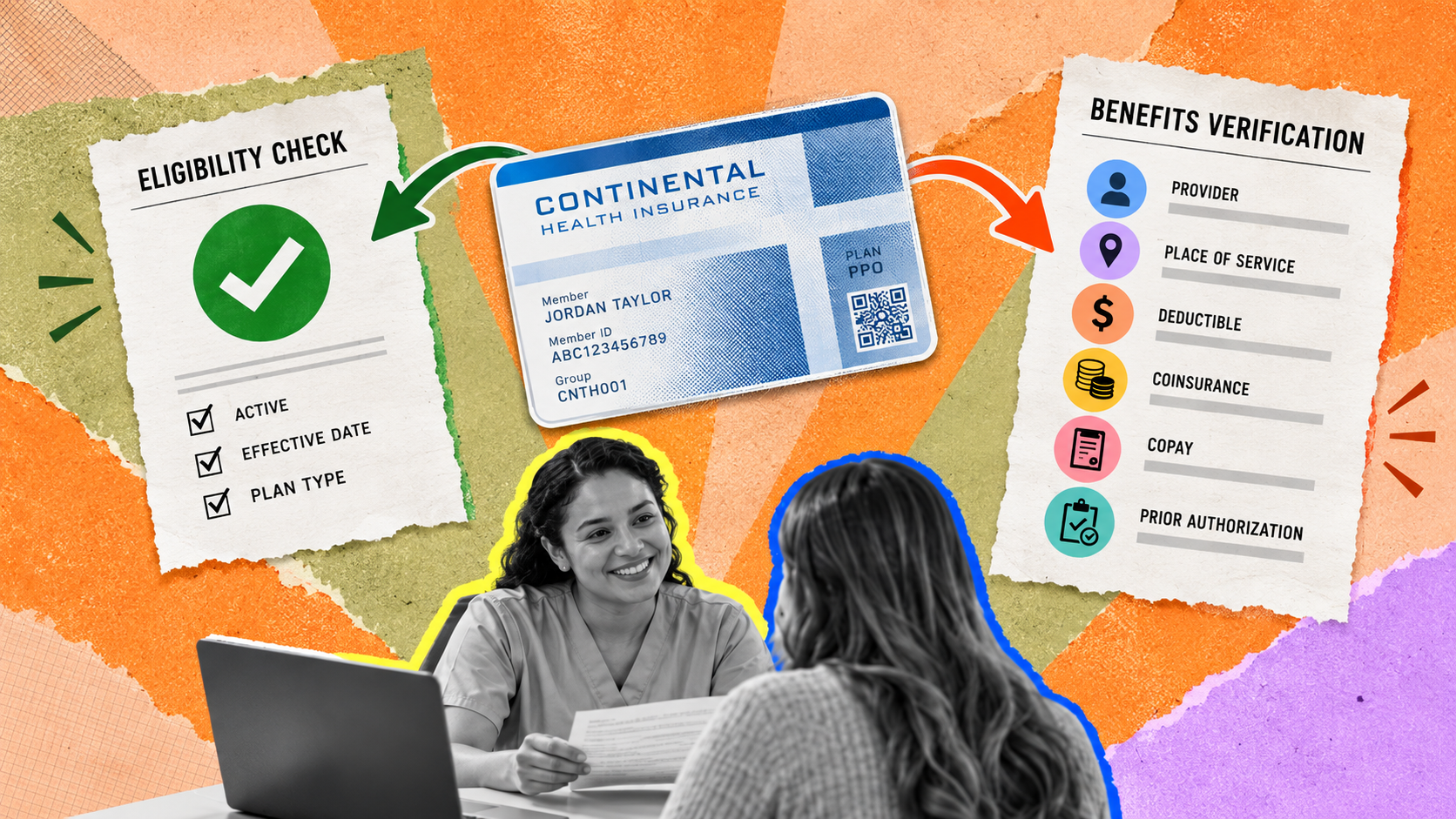
Eligibility verification confirms that a patient's insurance is active and returns basic plan details. Benefits verification (also called verification of benefits, VOB, or a benefits investigation) goes further: it works out how a specific CPT code will be covered for a specific provider, and exactly what the patient will owe. Eligibility tells you the patient has insurance. Benefits verification tells you what to collect and whether you need a prior authorization.
What does an eligibility check actually tell you?
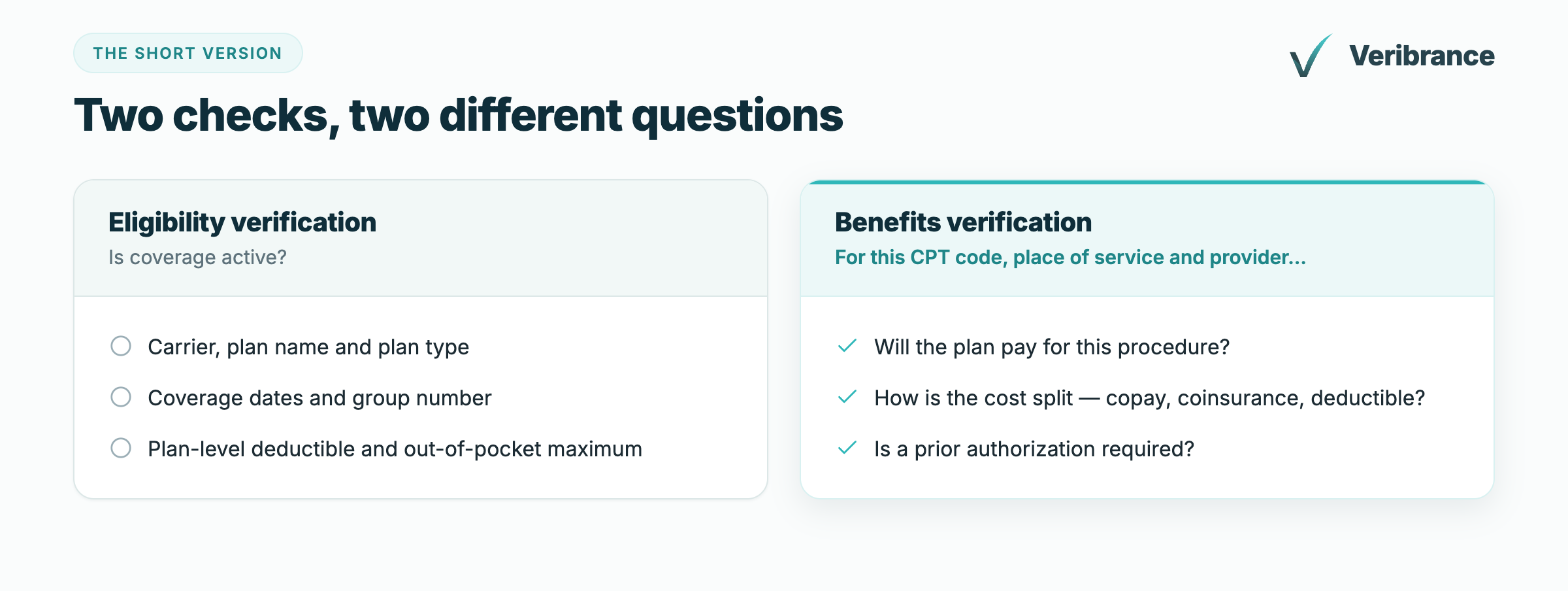
Eligibility verification is the check that happens whether or not anyone on your team thinks about it. Your EHR or clearinghouse fires off a 270 request, gets a 271 response back in a couple of seconds, and displays a status. It answers a narrow set of questions: Is this plan active today? Is the patient enrolled with the payer we're about to bill? What kind of plan is it, what's the group number, when did coverage start, and what are the plan's deductible and out-of-pocket maximum?
That's genuinely useful, and every scheduled appointment should get one. The problem is what the response looks like. A 271 can come back with dozens of lines of service-type codes and benefit amounts attached, which reads like a complete picture of the policy. It isn't. It's a dump of everything the policy covers in general terms, and you're left to guess which of those lines applies to the specific patient, procedure, and provider in front of you. Most of the time the response can't tell you how a given service will be adjudicated at your location, and it almost never tells you reliably whether that service needs prior authorization. (Our mental health eligibility guide walks through what a 271 does and doesn't say for behavioral health codes, where carve-outs make this especially messy.)
So eligibility gives you a basic picture. What it doesn't give you is a financial one.
What does benefits verification add?
Benefits verification starts where eligibility stops. Instead of asking "is this plan active," it asks "what happens when this procedure is billed by this provider for this patient."
To answer that, it has to go CPT-code deep. Does the deductible apply to this service at all? If so, which one: individual or family, embedded or aggregate, in-network or out-of-network? How much of it is left as of today? Is there a copay, coinsurance, or both, and what are the actual amounts for this code? Does this service count toward the out-of-pocket max, and has that max already been met? Are there visit or unit limits, and how many have been used? Is the rendering provider in network for this plan, at this location, in this tier? And does the payer require prior authorization or a referral for this code?
Every one of those answers moves the patient's bill, and none of them show up in a standard eligibility response. Benefits verification is the piece that turns "has insurance" into "owes $340 today."
Here's the misconception that causes the most trouble: people assume the contracted rate with the payer is the patient's responsibility. It isn't. Your fee schedule tells you the price of the service. Benefits verification tells you how that price gets split between the payer and the patient. You can have a perfect fee schedule for every code you bill and still be unable to produce an estimate, because you don't know which benefit terms apply. If you want the full walkthrough of that math, including family deductibles, tiered networks, and coordination of benefits, our guide to insurance verification and patient estimation covers it step by step.
How do the two compare side by side?
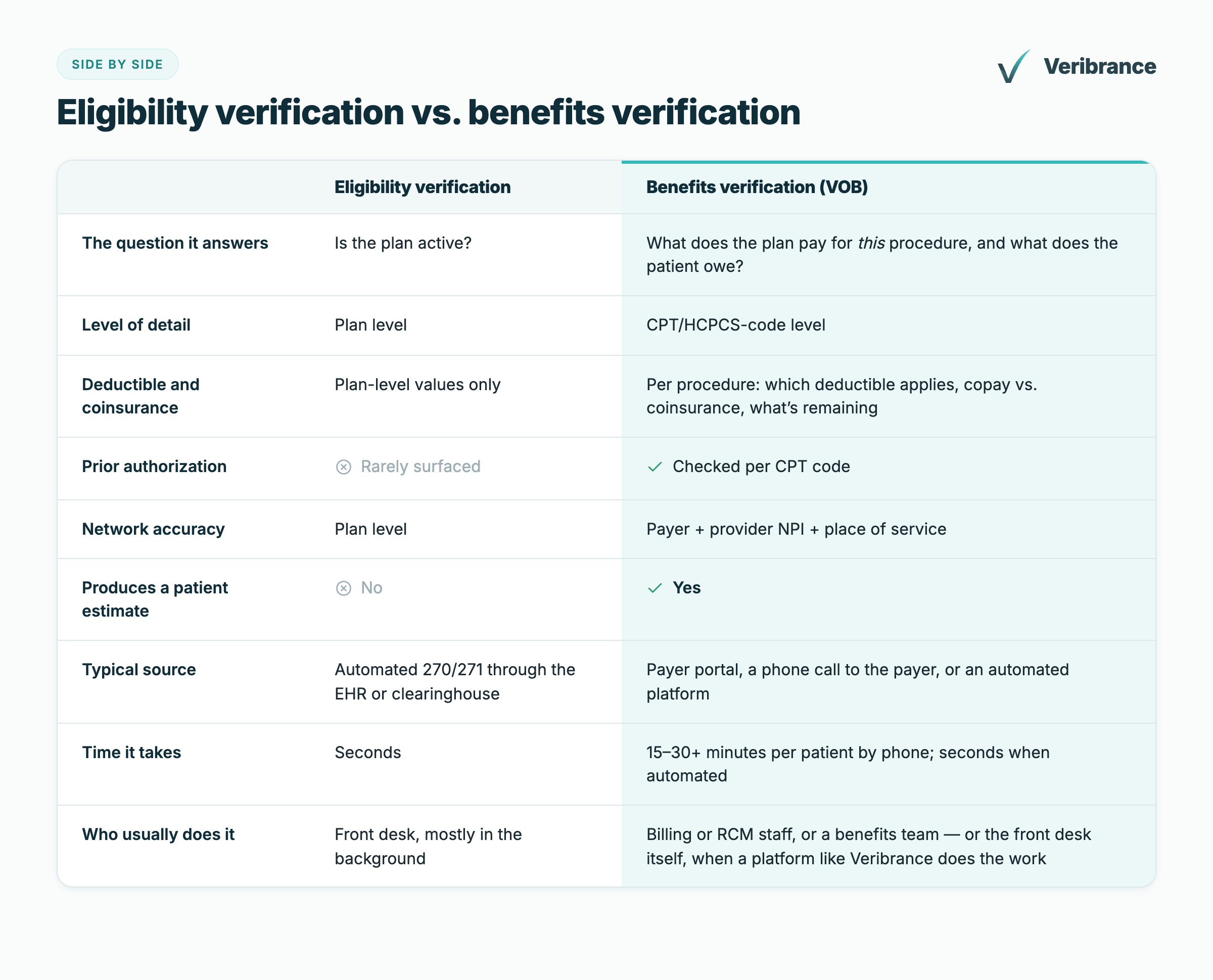
Nine dimensions separate the two checks. On each one, eligibility gives you the general answer and benefits verification gives you the specific one.
- The question it answers. Eligibility: is the plan active? Benefits verification: what does the plan pay for this procedure, and what does the patient owe?
- Level of detail. Eligibility: plan level. Benefits verification: CPT/HCPCS-code level.
- Deductible and coinsurance. Eligibility: plan-level values only. Benefits verification: per procedure — which deductible applies, copay vs. coinsurance, and what's remaining.
- Prior authorization. Eligibility: rarely surfaced. Benefits verification: checked per CPT code.
- Network accuracy. Eligibility: plan level. Benefits verification: payer plus provider NPI plus place of service.
- Produces a patient estimate. Eligibility: no. Benefits verification: yes.
- Typical source. Eligibility: an automated 270/271 through the EHR or clearinghouse. Benefits verification: a payer portal, a phone call to the payer, or an automated platform like Veribrance.
- Time it takes. Eligibility: seconds. Benefits verification: 15–30+ minutes per patient by phone, or seconds when automated.
- Who usually does it. Eligibility: the front desk, mostly in the background. Benefits verification: billing or RCM staff, or a benefits team — or the front desk itself, when a platform like Veribrance does the work.
How can you tell which one a process is actually doing?
Look at the inputs. Eligibility needs three things: the patient's name, date of birth, and member ID. Benefits verification needs those plus the CPT or HCPCS code, the place of service, and the rendering provider's NPI. If nobody asked for a code, a place of service, or an NPI, benefits were never verified. Eligibility was, and someone relabeled it.
Why doesn't "eligible" mean "covered"?
Two assumptions do most of the damage.
The first is "the patient is eligible, so I can bill." A policy can be fully active and still exclude the service, cap the number of visits, require authorization, or apply a separate deductible. Eligibility confirms the relationship between the patient and the payer. It says nothing about the relationship between your service and their plan.
The second is "plan-level numbers are close enough." They often aren't, because so many rules live at the service or provider level: network tiering, place-of-service differentials, employer carve-outs for behavioral health, separate out-of-network deductibles. The plan-level deductible field flattens all of that into one number that may not apply to the visit at all. Those two patients from the top of this post are the proof. Telehealth is another whole category of exceptions on its own; we've written about how price transparency plays out for telehealth and digital health providers specifically.
Where does each check belong in the workflow?
These two checks aren't rivals. They're for different moments.
Eligibility is the right tool at scheduling, at intake, and for sweeping large patient lists. It's cheap, it's fast, and it should run on every appointment without anyone lifting a finger.
Benefits verification belongs wherever money and rules meet: pre-visit financial counseling, patient estimates and consent, upfront collection, procedures that may need authorization, enrolling patients into programs like RPM or CCM. For most specialty practices that describes the majority of visits, because the patient's share is meaningful and the payer's rules are anything but simple. This is the heart of what we call patient financial clearance: finishing the financial conversation before the clinical one starts.
Practices that rely on eligibility alone are flying blind on the one number that matters most: what the patient will actually owe. That's the difference between collecting correctly at check-in and chasing the balance for the next four months. (Not sure whether upfront estimates are worth the effort for your practice? This short self-assessment will tell you in two minutes.) And patients increasingly expect that number before they walk in; we wrote about why in our post on pre-visit price transparency.
Does eligibility tell you whether prior authorization is required?
Not reliably, and this is where people most often expect eligibility to help and are most often disappointed. Some 271 responses include an authorization indicator, but it's inconsistently populated and rarely tied to a specific procedure, so you can't build a workflow on it.
A proper benefits verification flags PA requirements per CPT code using the payer's rules and, when it matters, confirms with the payer directly. For complex or patient-specific determinations, that confirmation may still mean a phone call. Keep in mind, though, that benefits verification tells you an authorization is required; obtaining it is a separate process. Veribrance handles that next step through its prior authorization services.
What does getting this wrong actually cost?
Optum's 2024 Revenue Cycle Denials Index, built on 124 million hospital claim remits, found that registration and eligibility problems caused 24% of all denials — the largest single category — and that 84% of denials were potentially avoidable.
Read that category name carefully, though. It doesn't mean those practices skipped the eligibility check; most ran one. It means the information gathered at the front of the visit didn't survive adjudication: wrong network status, a service the plan didn't cover the way anyone assumed, an authorization nobody knew was required. Running a 270/271 doesn't close that gap. Verifying the benefit for the actual procedure does.
Meanwhile, collecting is getting harder. Kodiak Solutions, across 2,100 hospitals and 300,000 physicians, put the initial denial rate at 11.81% in 2024 — and the collection rate from insured patients at 34.46%, down from 37.58% a year earlier. Every dollar you don't collect at the front desk gets harder to collect later.
And the volume is staggering. The 2024 CAQH Index counted 31.5 billion eligibility and benefit verifications in the medical industry in a single year, and CAQH estimates that moving the remaining manual work to electronic workflows could save upwards of $11.7 billion annually. A lot of that manual work is exactly the CPT-level benefits verification that eligibility transactions leave undone: the 15-to-30-minute payer calls that specialty practices still make by hand, every day.
At the level of a single practice, the story repeats itself. Patient shows as eligible. Nobody checked whether the procedure needed authorization or how much of the deductible was already used. Claim denied, or patient gets a bill nobody warned them about, or both. That's not an eligibility failure. It's a benefits verification gap. And it's why benefits verification sits near the top of our front-end revenue operations checklist, and why practices that get it right see the upfront collection gains that eligibility-only practices keep missing.
Why is benefits verification so much harder to automate?
Eligibility automation is a solved problem. The 270/271 transaction is standardized, clearinghouses return it in seconds, and it costs next to nothing. Benefits verification is harder because nothing about it is standardized. Payers describe the same benefit in different words. Rules vary by provider contract. The information you need is spread across portals, EDI, EOBs, and your own fee schedules, and someone (or something) has to map free-text benefit language onto CPT codes and apply the right deductible to the right service.
Automating that well takes three things. It takes provider-specific configuration — your fee schedules, contracted rates, NPIs, and places of service — so estimates reflect your reality instead of a generic allowed amount. It takes a feedback loop from actual EOBs, so the system learns how each payer really behaves and corrects its own exceptions over time. And it takes a confidence-based fallback: when the data is ambiguous, escalate rather than guess.
Do you really have to call the payer?
This is the question worth pausing on, because a whole crop of vendors has appeared in the last couple of years whose answer is "yes, and we'll have an AI make the call for you." That's a real capability, and Veribrance has it: when a benefit genuinely can't be resolved from data, our AI voice agents call the payer and get the answer. But we want to be clear about how we think about it, because it's the opposite of how that category is usually pitched.
Our approach has always been to make as few calls as possible. A phone call is the slowest, most expensive, and least consistent way to learn what a plan covers; two reps at the same payer will answer the same question differently on the same day. So Veribrance treats the call as a last resort, not a product. It exhausts the structured sources first — EDI, payer APIs and portals, the payer's published rules, your contracts and fee schedules, and what it has learned from your own EOBs — and resolves the large majority of verifications from data alone, in seconds, at 90–95% estimate accuracy. The voice agent picks up the phone only for the residual cases where nothing else can answer the question, and that share shrinks as the system learns your payer mix. That's why we don't think of ourselves as an AI phone-call vendor. We think of ourselves as a benefits verification platform that happens to know when a call is actually necessary. We've written more about where AI agents fit in benefits verification, and about how to manage automation and integrations across the revenue cycle without creating a new pile of exceptions.
The Veribrance platform verifies benefits at the CPT level, applies your fee schedules, flags prior-auth requirements, and returns a patient estimate in seconds, across the payers in our supported insurance directory. If you're curious how that compares with what your EHR's built-in check does, we laid it out in Veribrance vs. your EHR.
What mistakes do even good teams make?
Teams that already run benefits verification still trip over a familiar set of things. They skip the CPT code, the place of service, or the provider NPI, and get an estimate that's wrong in ways nobody notices until the EOB arrives. They use the plan-level "deductible remaining" as a stand-in for CPT coverage, which over- or under-estimates any time the service has its own rules. They assume payer portal outputs are consistent (they aren't, and the same benefit labeled three different ways leads to misclassification). They forget about secondary coverage, and coordination of benefits quietly rewrites the final patient responsibility. And they verify too early: deductible and out-of-pocket accumulators keep moving as other claims process, so a check done three weeks before a procedure can be stale by the day of service.
How do you put benefits verification in place?
If you're starting from eligibility-only, here's the order that works.
- Decide what you want from it. Front-desk estimates, pre-service counseling, price transparency, RPM/CCM enrollment, or all of the above.
- Inventory your top CPT codes and payers, starting with the high-volume, high-dollar combinations. That's where the money is.
- Pick an integration path that matches your team. Portal-first, CSV or bot-assisted, or straight to API/EHR integration for higher volume.
- Gather fee schedules and a stack of representative EOBs before go-live. They're what make estimates yours rather than generic.
- Define "Needs Review" and "Call Pending" — what they mean and who owns them — so low-confidence cases don't pile up in a queue nobody watches.
- Choose tooling that handles the hard part. A platform that resolves most verifications from data and escalates to a call only when it has to.
- Set KPIs before launch, not after: estimate accuracy, percentage automated, call volume, upfront collections, and days in A/R.
What does it cost, and how should you think about ROI?
Eligibility checks are usually bundled into your clearinghouse or EHR, or priced per batch at a trivial cost. Benefits verification is priced differently because it does more. The common shape is a one-time onboarding fee to configure your provider rules and fee schedules, a monthly minimum, and a per-verification fee, with voice calls for prior auth and deep manual research sold as add-ons. (Veribrance publishes its pricing, which is rarer in this category than it should be.)
The ROI math is simpler than it looks. Take your current cost per manual verification (staff time, hold time, retries). Compare it with the per-transaction or subscription cost. Then add what you'd gain from higher upfront collections and fewer write-offs and refunds, plus the hours you'd move from hold music to work that generates revenue. Realistic targets once you're running: estimate accuracy in the 90–95% range, a shrinking share of cases flagged low-confidence, noticeably fewer manual calls, higher point-of-service collections, and lower A/R days. Eligibility automation saves labor. Benefits automation is what moves collections. For a quick sense of the upside, the free Veribrance cost estimator is a good place to start.
What should you ask a benefits verification vendor?
Before you sign with anyone, ask whether they deliver CPT-level outputs or eligibility results relabeled as "benefits." Ask whether they can apply your fee schedules and handle NPI and place-of-service logic. Ask what onboarding involves, how long it takes, and how many EOBs they'll want. Ask what share of verifications they resolve without a phone call, because a vendor that calls on everything is selling you a call center with a chatbot on top. Ask how they handle low-confidence cases, whether there's a human or voice-agent fallback, and what the SLA is. Ask what add-ons exist for prior auth, insurance discovery, and EHR integration.
Then ask the one that matters most: can we run a pilot on 20 to 50 real patients and compare your outputs against the EOBs? Any vendor confident in procedure-level accuracy will say yes without hesitating.
Ready to stop guessing what patients owe? Veribrance automates CPT-level benefits verification and patient cost estimates for specialty practices, so your front desk collects the right amount the first time — and your staff stop living on hold. Book a demo or try the free cost estimator.
Sources cited in this post
- Optum — 2024 Revenue Cycle Denials Index (124M hospital claim remits, $500B in charges, 1,400+ hospitals — 24% of denials from registration/eligibility; 84% potentially avoidable)
- Kodiak Solutions, via TechTarget — Initial claim denial rates put revenue cycle in tough spot (2,100+ hospitals, 300,000 physicians — 11.81% initial denial rate; insured-patient collection rate 34.46%)
- AJMC — 2024 CAQH Index Foresees Major Opportunity for Health Care Savings (31.5B verifications; $11.7B savings opportunity)