
What is the best CPT-level benefits verification software?
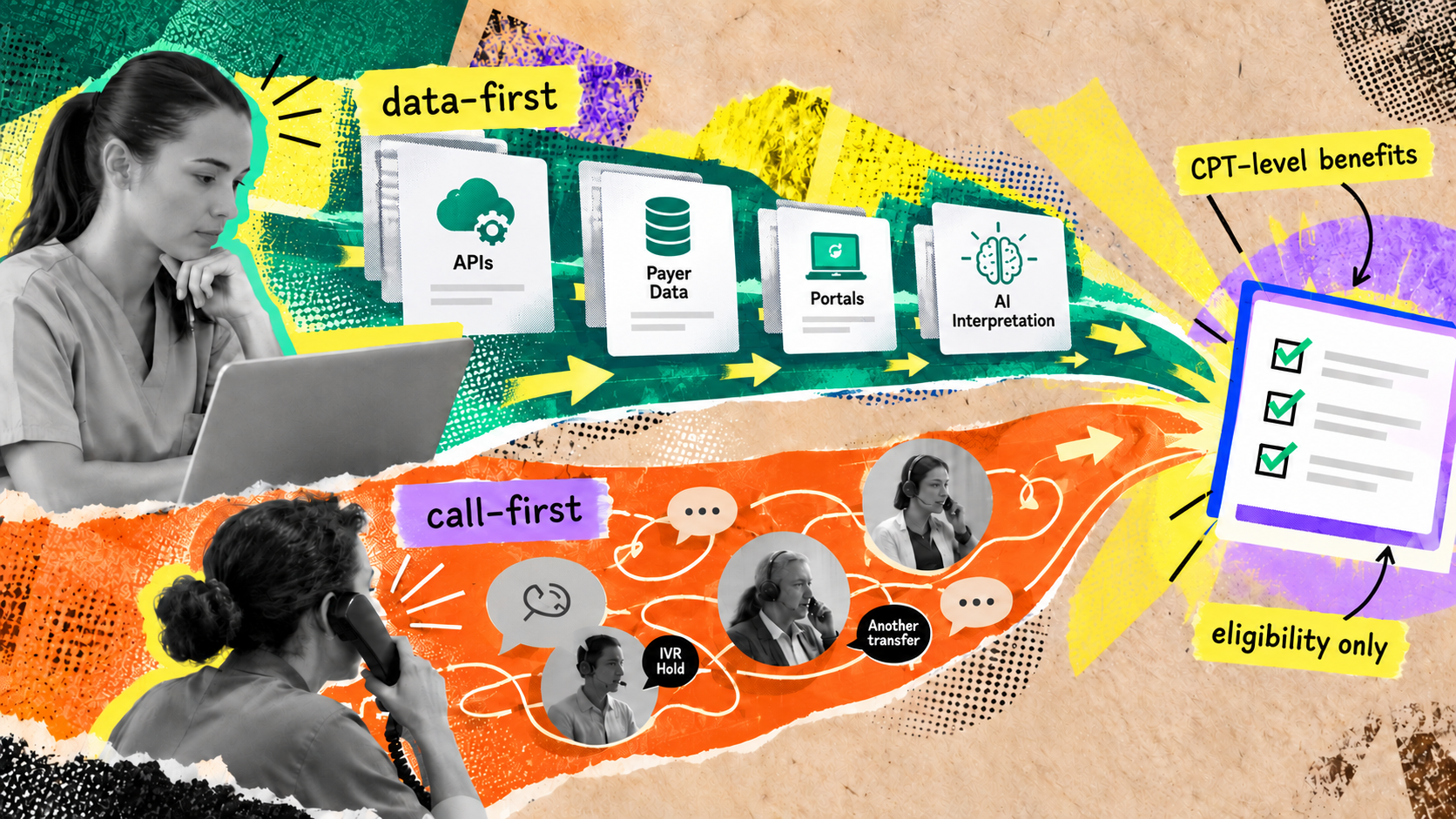
Quick answer: CPT-level benefits verification software tells you how a patient's plan covers a specific procedure code, for a specific provider and place of service, and turns that into a dollar estimate. Of the 12 tools we compared, most stop at eligibility and plan-level benefits. Only one states all three: CPT-level benefits, a patient estimate in dollars and your fee schedule applied. That tool is Veribrance, which we make, so every tool below is scored on the same six questions.
What is CPT-level benefits verification?
CPT-level benefits verification confirms how a patient's plan covers a specific CPT or HCPCS code, for a specific rendering provider, at a specific place of service. It returns whether the code is covered, which deductible applies and how much is left, the copay or coinsurance, visit limits, network status and prior authorization rules. With the provider's fee schedule applied, it produces the patient's estimated cost.
| Eligibility check | CPT-level benefits verification | |
|---|---|---|
| Answers | Is the plan active? | What will the patient owe for this procedure? |
| Inputs | Name, date of birth, member ID | The same, plus CPT or HCPCS code, place of service and rendering provider NPI |
| Output | Active or inactive, plus plan-level copay and deductible | A dollar estimate for the visit |
| Source | 270/271 transaction, payer portal or EHR eligibility tab | Plan rules resolved against the code, provider, payer contract and claim history |
For the full distinction, read our explainer on eligibility vs. benefits verification.
How we evaluated these tools
We asked six questions of every vendor, answered from each company's own public materials. Where a vendor does not publish an answer, we say "not stated".
- CPT-level benefits: does the output cover this procedure, for this provider, at this place of service?
- Dollar estimate: does it return what the patient owes, not just percentages and remaining deductibles?
- Fee schedule: does it apply your contracted rates? There is no real estimate without them.
- How it gets the answer: structured data, payer portals or phone calls, and which one is the default?
- Calls to the payer: what share of verifications needs a call? Calls are the slowest and most expensive channel.
- Public pricing: can you see the price before a sales call?
The comparison table
On a phone, scroll the table sideways to see every column.
| Tool | CPT-level benefits | $ patient estimate | Uses your fee schedule | How it gets the answer | Calls the payer? | Public pricing |
|---|---|---|---|---|---|---|
| Veribrance | Yes | Yes | Yes | Data first; AI voice call as fallback | Under 5% of cases | Yes: $399/mo + setup |
| Collectly Billie AI | Stated (CPT and ICD context) | Not stated | Not stated | AI reads 271 and portal data | Not stated | No |
| Prosper AI | Yes, by phone | Not stated | Not stated | API first, then AI voice call | About 20% (implied by its stated 80% via API) | No |
| SuperDial | Service-specific; CPT-level not stated | Not stated | Not stated | AI voice, plus portals, APIs, EDI | Yes, voice-led | No |
| Infinitus | Yes, by phone | No | No | Digital first, then AI voice | Yes, voice-led | No |
| pVerify | No, plan-level | Plan-level only | No | 270/271 via API or portal | No | Yes |
| Stedi | No, raw 271 | No | No | 270/271 API | No | Yes |
| Availity Essentials | No, plan-level | No | No | Multi-payer portal, 270/271 | No | No |
| Experian Patient Access Curator | No, eligibility correction | No | No | AI review of the 271 | No | No |
| Waystar | No, coverage detection | No | No | Clearinghouse plus AI | No | No |
| Adonis | Not specified | Not stated | Not stated | Agentic RCM platform | Not stated | No |
| Notable Health | No, plan-level | No | No | Card capture plus real-time eligibility | No | No |
Reading the table: infrastructure tools and enterprise platforms return eligibility and plan-level benefits, and they do it at scale. Call-first vendors can reach procedure-level detail, but none states a dollar estimate or fee schedule. Veribrance is the only tool that states all three, with more than 95% of verifications completed without a payer call.
Tools that return a CPT-level estimate
Veribrance (our product)
- Best for: outpatient practices, telehealth, DME suppliers and diagnostic centers that need a patient estimate before the visit, not just a green checkmark. See specialties.
- What it returns: network status for the payer, provider and location; which deductible applies and how much remains; copay or coinsurance for the code; visit limits; prior authorization rules; then a patient estimate and a plain-language benefit summary.
- How it works: SmartVerify AI resolves from data first, using EDI and payer connections, payer- and provider-specific logic, and your own payer contracts and claim history. More than 95% of verifications finish without a payer call. An AI voice agent handles the rest, and a person reviews the output.
- Accuracy: 90 to 95% estimate accuracy against the final EOB.
- Works with: your EHR or practice management system via API, a web app, or a patient-facing website widget.
- Pricing: $399 a month plus one-time setup. First 500 patient estimates each month free. No long-term contract.
Call-first vendors
These tools send an AI agent to phone the payer, work through the IVR, wait on hold and talk to a representative. That can reach procedure-level detail a plan-level check will miss. The trade-off is time, cost and consistency: every call has a length and a price, and two representatives at the same payer can give different answers on the same day. None of the three states a dollar estimate or fee schedule.
- Prosper AI: outpatient groups across 13+ specialties. States that 80% of verifications resolve through an API first pass, with the rest sent to voice agents. Pricing not public.
- SuperDial: built for RCM companies and dental groups with high call volume. Returns coverage, deductibles, copays, out-of-pocket balances, carve-outs, network status and authorization requirements, with transcripts. CPT-level not explicitly stated. Pricing not public.
- Infinitus: built for pharmaceutical manufacturers and payers running benefits verification at national scale. Unlikely to target outpatient practices. Pricing not public.
Other vendors to know: Sohar Health and Nirvana serve behavioral health and telehealth with eligibility, network status and cost estimates, but do not state CPT-level detail. Collectly's Billie AI, a module of its patient payments platform, reads 271 and portal data with CPT and ICD context but does not state a dollar estimate or fee schedule. Silna Health focuses on ABA, physical therapy and cardiac rehab, with per-transaction pricing. Infinx pairs AI with its own RCM staff for exceptions.
Tools that stop at eligibility
These are the networks most US eligibility data runs through, and the platforms built on them. They confirm whether a plan is active and return plan-level benefits at scale. None tells you how a specific procedure is covered or what to collect at the front desk.
- Availity Essentials: the largest multi-payer network; real-time eligibility and plan-level benefits in one portal.
- Optum Enhanced Eligibility: the 270/271 as a JSON API with a rules engine, for health systems and large groups.
- Stedi: a 270/271 API clearinghouse for developers, with public per-transaction pricing.
- pVerify: real-time eligibility across 1,500+ payers via API or portal, with public monthly pricing.
- Experian Health Patient Access Curator: reviews the 271 to fix coordination of benefits and registration errors. This is eligibility correction, not benefits verification.
- Waystar: coverage detection inside its RCM platform, to find active coverage for self-pay patients.
- Adonis: an eligibility and benefits agent inside its agentic RCM platform; how the check works is not specified.
- Notable Health: reads the insurance card, checks coverage in real time, and writes copay, deductible and prior authorization flags back to the EHR.
If your problem is registration quality, coordination of benefits or self-pay patients who have coverage, these are the right tools. If your problem is what the patient owes for the procedure being scheduled, they are the input, not the answer.
Do portal-reading AI agents give CPT-level benefits?
Not on their own. Some newer vendors log into payer portals and read benefits "from the source." Automating the login is real and saves clicks, but the portal shows the same plan-level summary as the 271. It does not know the rendering provider's contract or your fee schedule, so it cannot end in a dollar figure. Ask the same two questions of these tools as of any other: does it take the CPT code, place of service and rendering provider NPI, and does it end in a dollar amount you can collect?
How to choose: pick by problem
| Your main problem | What you need | Tools to look at |
|---|---|---|
| Knowing what the patient owes before the visit | CPT-level verification with a dollar estimate | Veribrance |
| Registration errors, coordination of benefits, self-pay patients who have coverage | Eligibility correction and coverage discovery | Experian Patient Access Curator, Waystar, Notable |
| Staff hours lost on payer phone calls (RCM companies, dental groups) | Call automation | Prosper AI, SuperDial |
| Eligibility inside your own software | A 270/271 API with public pricing | Stedi, pVerify |
How to run a fair pilot
- Pick 20 to 50 upcoming patients across your top payers and most common CPT codes.
- Run each patient through the tool before the visit and save the estimate.
- Wait for the EOBs to arrive.
- Compare each estimate with the patient responsibility on the EOB.
- Count how many verifications still needed a staff call or portal check.
For more questions to ask, see Insurance Verification, Answered.
Frequently asked questions
What is CPT-level benefits verification?
It is benefits verification done for a specific procedure code. It confirms how the plan covers that CPT or HCPCS code for the rendering provider and place of service, including deductible, copay or coinsurance, visit limits, network status and prior authorization. With the fee schedule applied, it produces the patient's estimated cost.
What is the difference between eligibility verification and benefits verification?
Eligibility verification confirms that a patient has active coverage on the date of service. Benefits verification confirms what the plan pays for a specific service and what the patient owes. Eligibility is the first step; benefits verification is what the front desk needs to collect. Read the full comparison.
Can a 270/271 eligibility check return CPT-level benefits?
Rarely. The 270 request can include a procedure code, but most payers respond by service type category, not by CPT code. The 271 also does not include your fee schedule, so it cannot produce a dollar estimate on its own.
Which tools verify benefits at the CPT level?
Of the tools here, Veribrance states CPT-level verification and returns a patient estimate with your fee schedule applied. Collectly Billie AI describes CPT- and ICD-aware interpretation. Prosper AI, SuperDial and Infinitus can reach procedure-level detail by phone. The other tools return plan-level benefits.
Do these tools call the insurance company?
Some lead with calls: Prosper AI, SuperDial and Infinitus use AI voice agents. Others resolve from data and call only when needed; Veribrance completes more than 95% of verifications without a call. Because calls are slower and cost more, the share that needs one affects your bill.
Which vendors publish pricing?
Stedi, pVerify, Silna Health and Veribrance. They are not like-for-like: Stedi and pVerify price the eligibility transaction only. The fair comparison is against the staff hours your team spends on verification. Use the staffing cost calculator to estimate yours.
How accurate is CPT-level benefits verification?
Vendor claims range from 90% to 99%, but they measure different things: transaction success, data-field accuracy or estimate accuracy against the final EOB. Ask which one a vendor means. Veribrance's 90 to 95% is estimate accuracy: how close the pre-visit number is to what the patient actually owed.
See it on your own patients
Try the free cost estimator, explore the interactive demo, or book a demo and we will run a pilot on your own cases.
Related reading: Best AI eligibility verification software · What is AI eligibility verification? · Payer phone numbers and portals · All insurance verification answers
Sources: vendor websites and product pages, reviewed November 2026; Stedi and pVerify pricing pages; funding coverage from Becker's, Fierce Healthcare, TechTarget and Business Wire.


